The contradiction between imperialism and the peoples of the oppressed nations is the principal contradiction on a world scale. The main front of this contradiction is in Iraq, where the Iraqi national resistance is in the process of defeating U.S. imperialism. Below you will find some articles about the resistance in Iraq and why they need and deserve the support of the antiwar movement. The Iraqi Resistance is a national liberation movement struggling against occupation for justice, peace, and self-determination. While "TROOPS OUT NOW" must remain the central and unifying slogan of the antiwar movement, raising political support for the Iraqi national resistance as the sole legitimate representative of the Iraqi people is one of the main tasks of Marxist-Leninists and of all genuine anti-imperialists in the movement today. This is true solidarity with the Iraqi people.
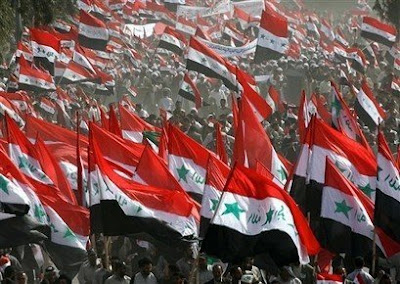
Voices of the Iraqi Resistance:Leaders of the Iraqi National Resistance Speak at an International Solidarity ConferenceBy Kosta Harlan
Chianciano, Italy - An historic conference with leaders of the Iraqi national resistance was held here last week. It was the first time that representatives of the Iraqi resistance have been able to speak in the West. Organizers had previously attempted to hold the conference in the fall of 2005, only to have the Italian government withhold visas from the Iraqi participants after intense pressure from the United States government. The scope of the conference extended beyond Iraq to include the resistance movements in Palestine and Lebanon, as well as representatives from the antiwar and liberation movements in countries from around the world.
(read the rest:
http://www.fightbacknews.org/2007/03/voices.htm)
--------------------------------------------------------------------------------
U.S. anti-war activist on speaking tour, tells of meeting with Iraqi resistanceBy staff
In March, U.S. antiwar activist and Freedom Road Socialist Organization member Kosta Harlan attended a historic international solidarity conference in Italy with leaders of the Iraqi resistance ( see “Voices of the Iraqi Resistance,” Fight Back!, March 2007). Since returning to the United States, Harlan has traveled to college campuses and cities across the South, speaking to hundreds of students and antiwar activists about the Iraqi resistance. He spoke at the University of North Carolina at Asheville, Chapel Hill, and Charlotte; at Winthrop University in South Carolina; at the University of Alabama at Tuscaloosa and at community centers in Winston-Salem and Minneapolis, Minnesota.
(read the rest:
http://www.fightbacknews.org/2007/06/antiwartour.htm)
--------------------------------------------------------------------------------
Petraeus, Bush vow to continue war
Movement to end war grows
By Josh Sykes and Staff
Reporting to Congress Sept. 11, General David Petraeus confirmed what most in the anti-war movement have long been saying: The U.S. has no intention of getting out of Iraq anytime soon - unless it is forced to.
In the course of the testimony and questioning before congress there was talk of the occupation continuing another five years or more. Figures in the Bush administration have compared the occupation of Iraq with the U.S. military presence in south Korea, an occupation that has extended more than half a century. In a speech two days later, Bush endorsed Petraeus’s recommendations, including a plan to ‘draw down’ U.S. troops to pre-surge levels. Practically, this means that the current number of U.S. troops, about 168,000, may be reduced to about 130,000 to 140,000 by next summer. The key phrase here is ‘may be.’ What’s certain is that the Bush administration and the Pentagon are planning an indefinite occupation of Iraq and that Bush is delivering on his promised ‘war without end.’
--------------------------------------------------------------------------------
The Iraqi Resistance is Just and Should be Supported:
A Reply to Phyllis Bennis
Kosta Harlan
August 11, 2007
In the four years of the U.S. occupation of Iraq, public debate within the U.S. antiwar movement on whether to support the Iraqi resistance has rarely taken place. Consequently the recent polemic between Alexander Cockburn and Phyllis Bennis (a leader in the United for Peace and Justice Coalition) is an extremely positive development and should be welcomed. It is an important debate that needs to take place at all levels within the U.S. antiwar movement.
Some weeks ago Alexander Cockburn wrote of the need for the U.S. antiwar movement to openly support the resistance ("Support their troops?," CounterPunch). In her reply, "Why the Anti — War Movement Doesn't Embrace the Iraqi Resistance", Bennis correctly argues that the basis of unity in the movement should not be "Victory to the resistance", but the demand "Troops out now". But Bennis goes further and argues that anti — imperialists have no responsibility to raise support for the Iraqi resistance. Bennis says that the Iraqi resistance is illegitimate (with some arrogance, she refers to the Iraqi resistance in quotation marks) and is therefore undeserving of support. This conclusions rests on a number of erroneous arguments, concentrated here in one paragraph of her article:
(read the rest:
http://www.mltoday.com/Pages/IraqWar/Harlan-ReplytoBennis.html)
--------------------------------------------------------------------------------
Interview in Madrid with Abu Muhammad, spokesman of the patriotic and nationalist Iraqi Resistance“The Iraqi Resistance is the legitimate and sole representative of Iraq”
CEOSI, Madrid, 8 October 2007
IraqSolidaridad (www.iraqsolidaridad.org),
10 December 2007
Translated from Spanish for IraqSolidaridad by Sabah Assir, revised by Ian Douglas
“The Iraqi Resistance has no relation with Al-Qaeda, which has its own vision, strategy, purposes and resources. One part of the assassinations that are now taking place in Iraq are executed by Al-Qaeda and another part by the militias and death squads linked to the political parties [invested in the US-imposed political process and] related to the occupation, but which also count on the assistance of Iran through its intervention in Iraq. […] The objective of the Iraqi Resistance is to achieve a total liberation. When the occupiers leave Iraq we will establish a national democratic, multiparty system, based on free elections; a regime in which all Iraqis that believe in collective rights will participate.”
(read the rest:
http://iraqsolidaridad.org/2007/docs/10-12-07-Entrevista_Abu_Mohamad_ingles.html)
--------------------------------------------------------------------------------
Iraqi Resistance Demands U.S. Withdrawl and Recognition
Published Oct 20, 2007 7:16 AM
Workers World managing editor John Catalinotto participated in interviews in Madrid on Oct. 10 with Abu Muhammed, a spokesperson for both the post-invasion Arab Socialist Ba’ath Party in Iraq and for the Supreme Command of the Front for Struggle [Jihad] and Liberation in Iraq (FSL), whose formation was announced Oct. 2. This front is one of the major coalitions or fronts of organizations that participate in the Iraqi National Resistance (INR) to the U.S. occupation.
This was the first set of interviews by an official representative of a major coalition of the Iraqi resistance outside the Middle East. He came to Spain at the invitation of the group CEOSI (iraqsolidaridad.org) and held media, political and institutional meetings.
'US is the main irritant in Iraq'
By Ahmed Janabi
Sheikh Harith al-Dhari, head of the Association of Muslim Scholars, is arguably one of the most influential Iraqi Sunni leaders today. His unequivocal opposition to the US-led occupation and criticism of the Nouri al-Maliki government attracted threats against his life and forced him into exile.
In an interview with Al Jazeera, al-Dhari says the slight improvement in the security situation in Iraq "is due to a decision by the Iraqi government to reign in its death squads".
Iraq - Eye to Eye with the Occupation • Chapter III: The Historical Roots of Resistance
First published in French and Dutch in May 2004, Iraq: Eye to Eye with the Occupation by Mohamed Hassan, former Ethiopian diplomat and Middle East specialist, and David Pestieau, Belgian journalist (www.solidaire.org) has now been translated into German, Italian and Turkish.One of the first books on the occupation of Iraq, it gives facts and analysis on the historical, political and social roots of the Iraqi resistance against the US army and its allies.
(read the rest:
http://www.solidaire.org/scripts/article.phtml?section=A3AAABBSBA&obid=26821)
--------------------------------------------------------------------------------
FRSO Fifth Congress Resolution:Victory to the Iraqi ResistanceAs the U.S. occupation of Iraq enters its fifth year, the Freedom Road Socialist Organization salutes the Iraqi resistance in its heroic struggle to liberate Iraq from imperialism and colonialism. We join with progressive forces around the world in recognizing that the victory of the Iraqi resistance is the only possible path towards a just peace in Iraq.
FRSO condemns the U.S. occupation of Iraq as a crime against humanity. Millions of people are suffering daily under the boot of military dictatorship. Hundreds of thousands have died in the four years of occupation. Millions live as refugees, both in and outside of Iraq. The U.S. has established a sectarian puppet "government," bound hand-and-foot to Washington, and calls it "democracy." FRSO calls on the antiwar movement to refuse any support to this puppet regime and recognize the national resistance as the sole legitimate representative of the Iraqi people.
(read the rest:
http://www.frso.org/about/5congress/resolutioniraq.htm)
--------------------------------------------------------------------------------
The Movement Against War in Iraq:A New Period and Our TasksBy Freedom Road Socialist Organization
Lessons From 17 Years of Aggression and Resistance
Iraq has been under attack by the United States government and military for the past 17 years. The current war and occupation has lasted for four years, and the U.S. faces military defeat by the Iraqi resistance. The American people do not support the war and want the troops brought home. It is an important time to look back at the movement against the war, try to learn some of the lessons that are available and look ahead to the tasks for the U.S. anti-war movement.
(read the rest:
http://www.frso.org/about/statements/2007/antiwartasks2007.htm)
--------------------------------------------------------------------------------
FRSO Fifth Congress:Main Political Report 2007International SituationIntroduction
Since 2004, the international situation has continued to develop in a way that is extremely favorable for the world’s peoples to make gains. In fact, the imperialist centers have been dealt heavy setbacks. On a general level we can say that the four basic contradictions are sharpening–between imperialism and the peoples of the oppressed nations, between the imperialist powers, between the working class and the capitalists, and between socialism and capitalism–and that this intensification of the basic contradictions exists in the context of the long-term decline of U.S. imperialism. (1)
The principal contradiction in the world today is between the peoples of the third world (2) and imperialism. The U.S. is the preeminent imperialist power in the world today and as such it is the main danger to the world’s peoples.
(read the rest:
http://frso.org/about/5congress/mpr2007.pdf)
--------------------------------------------------------------------------------
Meeting Resistance: A Documentary Film about the Resistance in Iraq
What would you do if America was invaded?
(check it out:
http://www.meetingresistance.com/)
--------------------------------------------------------------------------------
Labels: antiwar movement, Fight Back, FRSO, imperialism, Iraq, Iraqi Resistance, Middle East, national liberation, Workers World
View Post