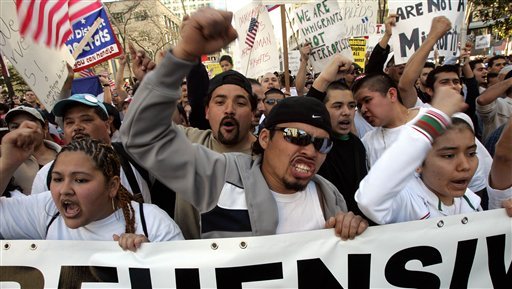
On April 10th, cities where immigrants were unknown twenty years ago held large rallies—40,000 in Minneapolis, 20,000 in Indianapolis, 20,000 in Salt Lake City and 50,000 in Atlanta. In the historically Mexican states of the Southwest, the movement is large and strong with 500,000 marching in Dallas, Texas, 50,000 in Denver, Colorado, 50,000 in San Diego, and 35,000 in San Jose, California. Immigrants in the U.S. have been hiding in plain sight for twenty years, but now with the huge marches and rallies there is a new understanding of how much power these workers have.
What are the political, trade-unionist, social forces behind it?Tom Burke: The political activists and trade unions are running to keep up with the movement of the people. For example, in Chicago, a Mexican immigrant school custodian and trade unionist, Artemio Arreola was one of the leaders of a small coalition that was surprised by the hundreds of thousands who thundered through the streets. He and others like him are organizing people from their villages, cities, and states in Mexico for over a decade now. The huge numbers of protesters is spontaneous, but working class and professional organizers provided the leadership and put out the message to oppose criminalization. Latino radio announcers broadcast the message far and wide. May Day will see a unified national day of action for immigrants rights across the U.S. and more unions are planning to take part in this. The grassroots activists are aware that their leadership will be challenged every step of the way by the forces tied to the rich and powerful, especially from the Democratic Party.
What are the demands of the movement?
Tom Burke: The demands are: to stop the criminalization of immigrants; to create an amnesty that leads to legalization of immigrants without papers; for equal rights for immigrants; for equality and justice for all.
What is the role of communists in the movement?
Tom Burke: The role of communists in the immigrants’ rights movement is small, but important. Many of the leaders were revolutionaries in their youth and some are influenced by Marxism today. There is a pressing need for unity in action, while maintaining principled political positions that advance the cause of the working class. Victories for immigrant workers are victories for Black and white workers. Bosses keep wages low, not immigrant workers. Capitalism is the problem. The profit system is the enemy.
What are the contradictions in the bourgeoisie, in the trade-union organizations? Tom Burke:
 There are sections of the capitalist class that oppose immigration and want to deport everyone. There are other capitalists that pay low wages and few or no benefits to immigrants. Lower wages means higher profits. The Republican Party is now split on the issue and a tremendous backtracking is happening. The Democratic Party has done little because it is easier to look the other way while immigrant workers are abused.
Some unions are very supportive of the movement, like the largest U.S. union—the Service Employees International Union. SEIU puts a good amount of effort and money into organizing amongst immigrants because that is who works in their industries. The same with UNITE/HERE that organizes factories and hotels and restaurants. At first these unions were hesitant and cautious, but now seeing the power of the movement they are coming out to provide support and help lead. For other unions, it is a question of local leadership, so carpenters unions in some cities are out in front leading, welcoming immigrants as union brothers. In other cities the union leaders are sitting on their hands, hoping the immigrants do not organize into unions. These leaders run the unions like a business and are racist against Black and Latino workers. There are fewer and fewer of these unions as they are failing. The unions that want to fight for good contracts for the workers and oppose discrimination are the ones that are growing and leading a new movement for social justice.
Tom Burke is Organizational Secretary,
Freedom Road Socialist Organization.