home

Tuesday, July 08, 2008

Harry Haywood on Trotskyism

"Trotskyism is taking action now in order to discredit Bolshevism and to undermine its foundations. It is the duty of the Party to bury Trotskyism as an ideological trend." - J. V. Stalin, "Trotskyism or Leninism?"

The great African American Marxist-Leninist theorist Harry Haywood is particularly known for his work on the African American national question, but he made contributions on other issues and was involved in the other struggles of the day. Here's what Harry Haywood, who lived in the Soviet Union for four and half years as a member of the Comintern, said in the chapter of his autobiography, Black Bolshevik, entitled "Trotsky's Day in Court" regarding Trotskyism.

First, he says that "[Trotsky's] writings were readily available throughout the school [KUTVA, where Haywood and others were studying], and the issues of the struggle were constantly on the agenda in our collectives. These were discussed in our classes, as they were in factories, schools and peasant organizations throughout the country" (p. 182).

He goes on to say that "The struggle raged over a period of five years (1922-27) during which time the Trotsky bloc had access to the press and Trotsky's works were widely circulated for everyone to read. Trotsky was not defeated by bureaucratic decisions or Stalin's control of the Party apparatus - as his partisans and Trotskyite historians claim. He had his day in court and finally lost because his whole position flew in the face of Soviet and world realities. He was doomed to defeat because his ideas were incorrect and failed to conform to objective conditions, as well as the needs and interests of the Soviet people" (ibid).

Haywood describes the Seventh Plenum of the Executive Committee of the Communist International in 1926:

"Stalin made the report for the Russian delegation. Trotsky then asked for two hours to defend his position; he was given one. He spoke in Russian, and then personally translated and delivered his speech in German and then in French. In all, he held the floor about three hours.

"Otto said it was the greates display of oratory he had ever heard. But despite this, Trotsky and his allies (Zinoviev and Kamenev) suffered a resounding defeat, obtaining only two votes out of the whole body. The delegates from outside the Soviet Union didn't accept Trotsky's view that socialism in one country was a betrayl of the revolution. On the contrary, the success of the Soviet Union in building socialism was an inspiration to the international revolution. (...)

"The American Party united across factional lines in support of Stalin. The Trotsky opposition, already defeated within the Soviet Union, was now shattered internationally. From there on out, it was downhill for Trotsky. I witnessed Trotsky's opposition bloc degenerate from an unprincipled faction within the Party to a counter-revolutionary conspiracy against the Party and the Soviet state. We learned of secret, illegal meetings held in the Silver Woods outside of Moscow, the establishment of factional printing presses - all in violation of Party discipline. Their activities reached a high point during the November 7, 1927 anniversary of the Revolution.

"At the Tenth Anniversary, Trosky's followers attempted to stage a counter-demonstration in opposition to the traditional celebration. I remember vividly the scene of our school contingent marching its way to Red Square. As we passed the Hotel Moscow, Trotskyist leaflets were showered down on us, and oraters appeared at the windows of the hotel shouting slogans of 'Down with Stalin.'

"They were answered with catcalls and booing from the crowds in the streets below. We seized the leaflets and tore them up. This attempt to rally the people against the Party was a total failure and struck no responsive chord among the masses. It was equivalent to rebellion and this demonstration was the last overt act of the Trotskyist opposition.

"During the next month Trotsky, Kamenev and Zinoviev were expelled - along with seventy-four of their chief supporters." (pp. 183-184).

Other helpful articles on Trotskyism are here:

"Preface to Trotskyism or Leninism?" by Harpal Brar of the CPGB-ML.
http://www.mltranslations.org/Britain/trotvslenin.htm

Similar but more concise:"Trotskyism or Leninism?: An Historical Outline" by Tim Logan (CPGB-ML) to the Stalin Society (UK)
http://leftspot.com/blog/?q=node/255

See also:"Critiques of Contemporary Trotskyism" - a collection
http://leftspot.com/blog/?q=trotskyism

On Trotskyism: Problems of Theory and History by Kostas Mavrakis
http://marx2mao.com/Other/OT73NB.html

"Trotskyism or Leninism?" by J. V. Stalin
http://marx2mao.com/Stalin/TL24.html

"The Trotskyist Opposition Before and Now" by J. V. Stalin
http://marx2mao.com/Stalin/TO27.html

Report of Court Proceedings: The Case of the Trotskyite-Zinovievite Terrorist Centre: Heard Before the Military Collegium of the Supreme Court of the U.S.S.R.
http://marxists.org/history/ussr/government/law/1936/moscow-trials/index.htm

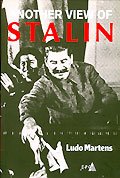
Another View of Stalin by Ludo Martens
http://www.plp.org/books/Stalin/book.html

Labels: , , , , ,


View Post

Monday, June 19, 2006

On the National Question

When the Sino-Soviet split began folowing Khrushchev's denunciation of Comrade Stalin, the founder of the modern antirevisionist movement, Comrade Mao Zedong, wrote, first in Ten Major Relationships (1956), that "it is the opinion of the Central Committee that Stalin's mistakes amounted to only 30 per cent of the whole and his achivements to 70 per cent, and that all things considered Stalin was a great Marxist."

This simple ratio, 70-30, has done a great deal towards the evaluation of Stalin and has framed a substantial portion of the debate within the antirevisionist movement. Though I would argue that it is not so simple.

Only a year later, in Be Activists in Promoting the Revolution (1957), Mao wrote,

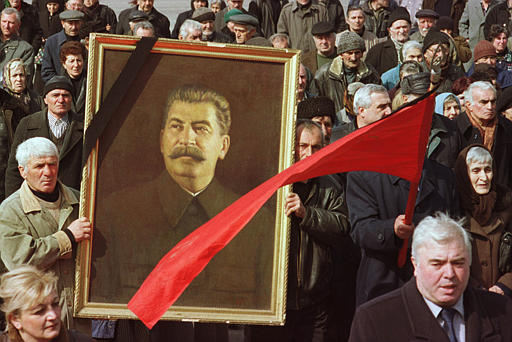
We have put Stalin's portrait up in Tien An Men Square. This accords with the wishes of the working people the world over and indicates our fundamental differences with Khrushchev. As for Stalin himself, you should at least give him a 70-30 evaluation, 70 for his achievments and 30 for his mistakes. This may not be entirely accurate, for his mistakes may be only 20 or even 10, or perhaps somewhat more than 30. All things considered, Stalin's achievments are primary and his shortcomings and mistakes are secondary. On this we take a view different from Khrushchev's.

It is strange that the question of Stalin is so unclear! In the interest of clarity it is therefore necessary to establish, bit by bit, which of Stalin's contributions must be chalked up as positive and which as negative. Thanks to a comment from Celtic Fire regarding how he "upholds Stalin" ("Stalin's definition of nationalities was wrong. Stalin's understanding of contradictions among the people was mechanical. And Stalin's understanding of socialist development was wrong"), we have a nice set of issues wherein to ground this question. So we shall go through each of these "errors" of Stalin, in the interest of "summing up the success and failures, and understanding how to advance," as Celtic Fire says.

First then, we shall look at Stalin's "definition of nationalities" and the application of the Marxist-Leninist national question in the Soviet Union. I intend to show here that we should chalk this one up on the "achievements" side of the 70-30 (or 80-20, or 90-10), and that, in summing it up and applying it to our conditions in the U.S., we can see how to advance.

Josef Stalin and the National Question in the Soviet Union

In 1912, Josef Stalin developed the Marxist-Leninist definition of a nation: "A nation is a historically constituted, stable community of people, formed on the basis of a common language, territory, economic life, and psychological make-up manifested in a common culture" (Stalin, Marxism and the National Question). This definition became the standard used in Marxist-Leninist analysis until the 50s when revisionism took over in the USSR and elsewhere. It influenced Communists the world over, including Lenin, who, in 1913 wrote that Stalin's work on the national question should be given "prime place" in theoretical Marxist literature (Lenin, The National Program of the R.S.D.L.P.).

We must remember that Russia, under the Tzar, was called the "prisonhouse of nations." The Lenin-Stalin line was that oppressed nations had the right to secession, that is, to seperate statehood. Just as Lenin, in the split with the Second International (the social-democrats of the Second International argued that the imperialist war taking place was benefitting the workers in the imperialist countries and should not be opposed), would make a central issue out of opposing "ones own" imperialist government, (see Lenin, Socialism and War), so to would he make an issue of dealing with imperialism within "one's own" country. Lenin addresses this at length in Right of Nations to Self-Determination (1914). He goes to great lengths to show that nations have a right to self-determination, that in the end, that means a right to political power, and even a right to seceed. Union is like a marriage. It is voluntary. Secession is a right, like divorce. Lenin also goes to great lengths to show that this does not mean a right to form bourgeois seperatist movements that will harm the international working class:

By supporting the right to secession, we are told, you are supporting the bourgeois nationalism of the oppressed nations ... Our reply to this is: No, it is to the bourgeoisie that a "practical" solution to this question is important. To the workers the important thing is to distinguish the principles of the two trends. Insofar as the bourgeoisie of the oppressed nation fights the oppressor, we are always, in every case, and more strongly than anyone else, in favor, for we are the staunchest and most consistent enemies of oppression. But insofar as the bourgeoisie of the oppressed nation stands for its own bourgeois nationalism, we stand against. We fight against the privileges and violence of the oppressor nation, and do not in any way condone striving for privilages on the part of the oppressed nation.

This is clear enough.

The most common criticism of Stalin's handling of oppressed nationalities first entered mass consciousness with the much publicized Islamic seperatist rebellion in Chechnya which began in 1991 with the declartion of Chechen independence from Russia. This matured into a civil war when Yeltsin sent in troops in 1994 to restore Russian authority. The Russian's were defeated and Aslan Maskhadov was elected and recognized by Russia as the presedent of Chechnya. In 1999 Chechens crossed into Dagestan to start another armed Islamic uprising and the war began anew with the Chechen mujahidin intending to set up an Islamic state based on Sharia law.

This violence is blamed, like most other problems in the former Soviet Union, on Stalin.

Stalin, as everybody knows, deported the Chechens en mass in 1944 hundreds of miles to the east of their homeland. Stalin's view was basically that, in general, the Chechens seperatist tendencies would serve the Nazis and that basically Hitler's armies would be able to recruit them into service agianst the USSR merely by handing out guns. Now, picking up something the size of Chicago and moving it over to New York in the middle of the largest and most brutal war in human history with very few available resources (such as transportation, trains, etc) would be no easy feat. This is roughly what Stalin achieved. Was it a difficult trip? Yes, of course it was. Was it necessary? Yes, I think it was. The leaders told the Nazis that they would support them if the Nazis would back Chechen independence (bourgeois seperatism; see also "Ethnic Crisis in the Caucuses). Stalin destroyed this nationalist revolt just behind the Caucasian line by picking up these people and moving them away from the front. They were not allowed to return until after Stalin's death, when they found other nationalities on the land they had so long considered theirs.

As Stalin himself says in Foundations of Leninism (1924):

[The right of nations to self-determination] does not mean that the proletariat must support every national movement, everywhere and always, in every individual case. It means that support must be given to such national movements as tend to weaken, to overthrow imperialism, and not to strengthen and perserve it. Cases occur when the national movements in certain oppressed countries come into conflict with the interests of the development of the proletarian movement. In such cases support is, of course, entirely out of the question. The question of the rights of nations is not an isolated, self-sufficient question; it is a part of the general problem of proletarian revolution, subordinate to the whole, and must be considered from the point of view of the whole.

Stalin's critics want to blame him for the problem but I just don't see the evidence for such a blanket claim. I don't see that the Stalin government had any other choice but to quell the Chechen seperatist rebellion and save the Soviet Union. This is Leninism.

Even so, there is reason to believe that the Chechen mujahidin might see things slightly differently than your average anticommunist. Let us just consider this quote from Celtic Fire's interview with Grover Furr:

The older Chechen fighters like Mr. Basayev occasionally refer to a common Soviet past when communicating with Russians. Maksim Shevchenko, a Russian journalist who interviewed him frequently during the first war, recalled one such appeal by Mr. Basayev, who wears the long beard of Islamic radicals."He switched off the tape recorder and he said, `You think I was always this bearded fighter with a machine gun?' " recalled Mr. Shevchenko, who at the time was writing for the daily Nezavisimaya Gazeta. " `I also sang the song, "My address is not a home or street; my address is the Soviet Union." Those were very good times.' " (“With Few Bonds to Russia, Young Chechens Join Militants.” NYT November 19, 2002.)

One of the points Furr makes that I agree with in that interview (I agree with his positive assesment of Stalin on the national question in general) is that "Great-Russian chauvinism got progressively worse after Stalin died. But it never got to the point it is now."

Harry Haywood and the National Question in the United States

The South controls the nation and Wall Street controls the South - W.E.B. DuBois

Of course the Lenin-Stalin line on the National Question was not only applied in the Soviet Union, but in other Comintern countries as well. Comrade Harry Haywood was a leading African American Communist who was in the Soviet Union from 1925 to 1930. There he travelled extensively and his observations of national relations in the former "prisonhouse of nations" are very positive, particularly in the Caucuses (see Haywood's critical and self-critical autobiography, Black Bolshevik: Autobiography of an Afro-American Communist). With the Comintern he worked to seek out solutions for the national question in the United States and South Africa.

It took intervention from Comrade Stalin and the Comintern to put an end to the factionalism that was on the verge of tearing apart the young CPUSA. Additionally, Stalin and the Comintern had to intervene in the CPUSA's line on the national question, which had long suffered from white chauvanism. As the pioneering theorist of the national question in the United States, Haywood's theoretical contributions are tremendous. Apart from the two Comintern Resolutions on the African American National Question (1928 and 1930) which Haywood helped to draft, his major contributions to the Lenin-Stalin line on the national question were in his book Negro Liberation (1948) and the pamphlet For a Revolutionary Position on the Negro Question (1957), where he analyzes conditions in the U.S. and developed the theory that African American people made up an oppressed nation with territory in the Black Belt South. He argued, basically, that the Hayes-Tilden comprimise of 1877 had left unfinished the agrarian bourgeois democratic revolution of Reconstruction, leaving African Americans frozen as landless semi-slaves in the South, forged into nationhood by the uneven development which accompanies the rise of monopoly capitalism. African Americans found themselves shifted abruptly from revolution to Jim Crow and Klan terror. (Please see also, Lenin, Capitalism and Agriculture in the United States of America, particularly the section on "the former slave-owning south".)

This being the case, the only way to develop the revolution would be for the CPUSA to demand self-determination in the South and full equality throughout the rest of the country. Without this demand the CP could not dream of giving leadership to the national liberation movement and establishing genuine multinational working class unity. As Karl Marx himself put it, "Labor cannot emancipate itself in the white skin where in the black it is branded" (Capital).

It was this revolutionary line that gave rise to the struggle of the Sharecroppers Union in the 1930s. The battles of the Sharecroppers Union are some of the greatest moments of labor history. When the Great Depression hit, many small landowning farmers became tenant farmers and many tenant farmers were further disenfranchized. This left sharecropping, where tenants are provided with tools, land, and basic subsistance goods in exchange for a substantial portion of the value produced, basically a form of serfdom, as the dominant property relations in the rural South. The struggle to fight back advanced rapidly under the leadership of the party with the call for self-determination and agrarian revolution. The union grew to over 3,000 very militant members in a couple of years, at some points even involving armed struggle (see Robin D. G. Kelley, Hammer and Hoe: Alabama Communists During the Great Depression. Chapel Hill: University of North Carolina Press, 1990 for a thorough discussion of the sharecroppers struggle. It is also covered to lesser extent in Haywood's autobiography, as he was a participant).

The Freedom Road Socialist Organization document, The Third International and the struggle for a correct line on the African American National Question, sums all of this up rather well: "The net result was a developed base among all progressive classes in the Black community. The position of the multi-national working class was strengthened in the process, as was the communist movement." Of course, the document continues, revisionism damaged this severely:

While Marxist-Leninists inside the Communist Party waged a serious fight to oppose revisionism on a host of questions - including a defense of a revolutionary line on the African American National Question - in the end it proved necessary to break with revisionism and to create new communist organizations. In the 1960s many of these anti-revisionists, including Harry Haywood and others who grasped the importance of the African American national movement, were able to propagate an advanced line to a new generation of communists.

The Civil Rights Movement then was forced to grow up in a world where the CP, the party of the proletariat, had abandoned its revolutionary line on the national question. This left the party to tail behind the NAACP and Martin Luther King. Therefore we saw the development of the bourgeois democratic revolution fall under the leadership of rightists, and we saw the institutionalization of bourgeois right in the South with the passage of the Civil Rights Act and Voting Rights Act. We saw where this led - to Watts and countless other uprisings accross the country and to the militant "Black Power" national liberation movement. For working class African Americans, little had changed. And, unfortunately, the New Communist Movement lacked the experience or unity to take an effective leading role.

Not that important reforms weren't won in the Civil Rights Movement. Some important and necessary gains were made. But we didn't win all that could be won, that's certian. Malcolm X put it so simply. After discussing revolution in the U.S., France, the Soviet Union, China, and Algeria, and discussing their common characteristics (namely land and bloodshed) he talks about the "Negro revolution", that is, the nonviolent Civil Rights Movement:

The only kind of revolution that is nonviolent is the Negro revolution. The only revolution in which the goal is loving your enemy is the Negro reovlution. It's the only revolution in which the goal is a desegregated lunch counter, a desegregated theater, a desegregated park, and a desegregated public toilet; you can sit next to white folks - on the tiolet. That's no revolution. Revolution is based on land. Land is the basis of all independence. Land is the basis of freedom, justice, and equality ("Message to the Grassroots").

The National Question for Marxist-Leninists in the U.S. Today

The evil system of colonialism and imperialism grew up along with the enslavement of Negroes and the trade in Negroes, and it will surely come to its end with the thorough emancipation of the black people. - Mao Zedong, "Statement calling on the People of the World to Unite to Oppose Racial Discrimination by U.S. Imperialism and Support the American Negroes in the Struggle Against Racial Discrimination"

There is nothing more important, more necessary for the revolution here in the United States, than the building of a strategic alliance between the multinational working class and the national liberation movements under the leadership of the genuine vanguard party of the proletariat. Only such a new Communist Party can play a leading role in the mass movements of all working and oppressed people.

Despite some outmigrations and industrialization, the African American Black Belt has persisted, along with the need for national liberation and socialist revolution. We see national oppression in the Black Belt and in the Chicano nation in the Southwest (Aztlan). Still we see the lag of uneven development in the South destroying the revolutionary possibilities of the working class all over the country, and as long as this domestic imperialism persists, there will never be revolution in the United States.

Haywood, struggling against the revisionism in the party, wrote "On the Negro Question" in 1959. This was his final intervention in the line of the CPUSA before joining with the nascent Maoist movement where he continued to fight for the revolutionary line on the national question. In "On the Negro Question" he states very clearly,

It cannot be stressed enough that the changes which have taken place in the Black Belt have sharpened immeasurably the contradiction involved in the Negro Question, and do not blunt them as the proponents of the draft resolution assert in their efforts to create a rationale for desertion of our internationalist obligation toward the oppressed Negro nation. The urbanization of the Negro people, the vast extension of the Negro working class, the growth of trade union membership, the emergence of free Asian and African nations, the changed relationship of world forces, have brought into being new and fresh forces, inspiring the Negro people with new aspirations and confidence, and severly sharpening the crisis of Wall Street-Dixiecrat rule in the South ("On the Negro Question," reprinted in, Towards Victorious Afro-American National Liberation: A Collection of Pamphlets, Leaflets and Essays Which Dealt In a Timely Way With the Concrete Ongoing Struggle for Black Liberation Over the Past Decade and More. Bronx: Ray O. Light, 1982).

The question is, as it has always been, one of power. This is the conclusion of the revolutionary Lenin-Stalin line on the national question. Chalk it up with the merits. Again we must raise the cry that our great teacher Harry Haywood raised.

Self-Determination for the African American and Chicano Nations!

Workers and Oppressed Peoples Unite!

Labels: , , , , , , , , , , , , , , , ,


View Post

Saturday, June 03, 2006

Revisionism and Capitalist Restoration: Contribution to the debate on the line of Freedom Road Socialist Organization

Some interesting discussion of revisionism and antirevisionism has come up lately, particularly in relation to the position put forward by Freedom Road Socialist Organization [Marxist-Leninist]. (People are using brackets these days it seems to distinguish by ideology the two groups that use the same name, the other being FRSO [Left Refoundationist]).

First Pottawatomie Creek (henceforth PC) struck at the line of the Marxist-Leninist FRSO (the publishers of Fight Back! Newspaper) with his article, FRSO [Fight Back!]'s Decent into Revisionism? to which Left Spot (LS) responded polemically in Debate on FRSO and Revisionism. Celtic Fire (CF) chimed in with Understanding Revisionism in an attempt to reopen the debate.

I'll summarize the debate thus far as I see it:

PC began by basically equating "revisionism" with not upholding the Left Refoundationists' Crisis of Socialism document, upholding the DPRK and the PRC as a socialist countries, and by referring to 1989 events in China as an attempted counter-revolution.

LS took note of these central points, and in my view, did pretty well at addressing them in his article.

Regarding the "Crisis of Socialism," LS addresses the defeatism of the statement.

While the statement makes some good points, its overall verdict on socialism in the 20th century is defeatist and is fundamentally wrong. The worst error of the Crisis statement is that it sums up all the efforts of socialist revolution in the 20th century as an overall failure. I quote: “overall the experience of building socialism in the Soviet Union must be summed up as a failure. All subsequent socialist revolutions have drawn to a great extent from the Soviet model, and the crisis of socialism is not confined to the Soviet Union.” This is straight-up wrong, and is drenched in the confusion and defeatism that much of the U.S. left succumbed to around 1991 when the statement was first adopted.

Regarding the socialist countries, LS notes some confusion regarding the Left Refoundationist line on the question.

And if they believe that Cuba is socialist [I understand there is a resolution put forward by FRSO [LR] to that effect], I would ask what FRSO [Left Refoundationist] sees as the distinction between the political economy of Cuba and that of, say, Vietnam, and why one is allegedly socialist and the other is allegedly capitalist.

And regarding the 1989 counter-revolutionary events at Tiananmen Square:

As for Tiananmen in 1989, would anyone deny that there were forces prominent, including some of the leadership, in the 1989 student movement that were aiming for Western-style capitalism? And that forces within the Chinese Communist Party that supported moving toward Western-style capitalism were working very closely with, and supporting, the protests?

He summed it all up, saying:

FRSO [ML] has successfully steered away from the many varieties of revisionism that have confounded many other groups. I think that compared to the alternatives, FRSO [ML] is the most advanced revolutionary organization in the US. FRSO [ML] is grounded in proletarian internationalism and Marxism-Leninism, incorporating key contributions of Mao Zedong and the Chinese revolution. FRSO [ML] engages in dynamic mass work using the mass line better than anyone else on the US left (to be fair, FRSO [Left Refoundationist] has some mass work I’m familiar with that is also very good). FRSO [ML] maintains a regular bilingual publication (Fight Back Newspaper www.fightbacknews.org) that highlights advanced experience in mass struggles around the country and world. And FRSO [ML] sees the need for Leninist organization and is building toward a new communist party to lead revolution in the US. That is not revisionism – that is Marxism-Leninism.

That's the essense of it.

Time I made my little contribution.

I think we've been messing around with secondary contradictions for too long in these debates. Lets get down to principal.

While some want to contest that while FRSO does some really good mass work, it isn't communist mass work. This seems to be, from what I've heard, because of a percieved lack of ideological content in Fight Back! I presume this to be the case, as I don't think those who have raised this have encountered much of FRSO's mass work first hand. I've worked along side some of these people for a while though, and I'd say that its very revolutionary, and that while Fight Back! may not be tailored for a petite bourgeois "communist" readership, it does well as a mass line publication to build the struggle among rank & file workers.

But that's not the crux of the matter.

Again and again on the blogs (not only the above mentioned blogs, but on Burningman's as well) we see the problem as coming down to the question of giving support to actually existing socialism. This gets to the heart of the issue: what is revisionism and what is capitalist restoration and how are they related? The crux of the argument seems to revolve around whether revisionism in command equals capitalist restoration, and further, what role is played by the dialectical relationship between relations of production and superstructure.

I would want to look at the history of the USSR and CPSU to get at this. Of course since we're talking about antirevisionism we'll have to get into the PRC and CPC as well. While it would be simple enough to use some of the documents from the Workers Party of Belgium which have dealt with the issue very throughly, I've done that here before and the trend is to dismiss them, apparently because they aren't "Maoist" in RIM sense of the term or because they don't see Mao as having surpassed Stalin. So, instead, I'll jump off of an article put out by the Communist Party of the Philippines (a group recognized around here as firm antirevisionists) in their theoretical journal Rebolusyon, number 2, series 1992, April-June. The article is "Stand for Socialism Against Modern Revisionism," by Armando Liwanag (some say this is the nom de guerre of Jose Maria Sison). It should be noted that this document represents the line of the organization at that time is approved by the Central Committee of the CP Philippines. I have the relevant issue in pamphlet form so I'll summarize the relevant passages, give page numbers, and quote where necessary.

Here (pp. 17-36) Liwanag outlines the "process of capitalist restoration" in the USSR through three stages:

The first stage is the Krushchev regime (1953-64). Ideologically this began with the secret speech to the XXth Congress of the CPSU - the slanderous diatribe against Comrade Stalin, successor of Lenin and architect of the world's first socialist society. Liwanag notes this "inspired the anticommunist forces in Poland and Hungary to carry out uprisings" and gave the green light to other Eastern European Rightists to "adopt captialist-oriented reforms." This was more or less the coming to power of an almost identical line as that put forward by Bukarin and the Right Opposition in the late 1920s and early '30s, which was defeated in the intra-party struggle by the Stalin-led party majority. This Rightist line meant putting "NEP style" reforms (liberalization and privatization of industry and agriculture and a turn toward a preference of light industry, that is, consumer goods, over heavy industry which had long been the backbone of socialist construction) in place.

Subjectivism reigns in the "blogosphere" where everyone really values their "independence" and a lot of claims and terms are thrown around like boulders without much of an attempt to scientifically think them through or back them up. "Brezhnevism" is one of those terms. Whereas it was once applied to those parties who were considered "puppets" of Soviet "Social-Imperialism" (as the Chinese called it) under Brezhnev, it is now thrown at anyone who thinks the Soviet Union during the Brezhnev period was still socialist. It is worth noting that if that is your charge (and it isn't mine), it must be leveled here against Liwanag, who considered the Breshnev regime (1964-82) to be the second of the three stages. While Liwanag states that in this period "socialism was converted fully into state monopoly capitalism" he goes on to say that the Gorbachav regime (1985-91) "marked the third and final stage in the anti-Marxist and antisocialist revisionist counterrevolution to restore captialism and bourgeois dictatorship." Here liberalization was extended from the base to the superstructure, with the legalization of the bourgeois parties, the institution of multi-party contested elections and the eventual liquidation of the CPSU and the USSR and the overturning of the socialist revolution. This marks the completion of a counter-revolution that took over 30 years.

To quote Liwanag:

To restore capitalism, the Soviet revisionist regimes had to revise the basic principles of socialist revolution and construction and to go through stages of camoflaged counterrevolution in a period of 38 years, 1953 to 1991. It is a measure of the greatness of Lenin and Stalin that their accomplishments in 36 years of socialist revolution and construction took another long period of close to four decades to dismantle. Stalin spent 20 years in socialist construction. The revisionist renegades took a much longer period of time to restore capitalism in the Soviet Union. (ibid. p.17)

This is more or less the same line on revisionism and capitalist restoration put forward by the WPB (see, for example, the International Communist Seminar 1999 Declaration, On Certain Aspects of the Struggle Against Revisionism (.doc), and Breznjev and the National Democratic Revolution for a few samples) and by the Marxist-Leninist FRSO. Revisionism is a real danger and counter-revolution is a lengthy process.

This means we are at the point where we must clearly define socialism. I'll use as a working definition the one put forward by Lenin in his Economics and Politics in the Era of the Dictatorship of the Proletariat.

Theoretically, there can be no doubt that between capitalism and communism there lies a definite transition period which must combine the features and properties of both these forms of social economy. This transition period has to be a period of struggle between dying capitalism and nascent communism -- or, in other words, between capitalism which has been defeated but not destroyed and communism which has been born but is still very feeble.

Now, some (mostly Maoists, and I count myself among those who uphold Marx, Engels, Lenin, Stalin, and Mao) argue that the instant persons come into power who take a revisionist line (who Mao and the Leftists in China called "capitalist roaders" for their desire to set the party and the state on the captialist, rather than the communist, road) capitalism is restored. In the past, we called this "Great Man Theory" and recognized it as metaphysical and unmarxist, but we'll put that aside for now (if you want a debate on Great Man Theory, please see the interventions put forth by LS in this debate on the role of Kim Jong Il and Kim Il Sung in North Korea that took place on Burningman's Blog). Surely we all know that the masses are the makers of history.

And this theory of instant capitalist restoration seems to discount the experience of the Cultural Revolution (GPCR) more than uphold it, contrary to what the proponents of this theory would like to have us believe. It is very clear that the call in 1966 was in fact to "bombard the headquarters" and to criticize and expose those "persons in power taking the capitalist road." The GPCR was also seen as an extension of the socialist revolution given the theory of "two line struggle" - the view that there are two roads in contradiction during the socialist transition to communism - the contradiction between captialist and communist relations of production - and thus two lines at odds with one another in the party at all times during the socialist revolution. This means that the Chinese understood this in such a way that revisionism in command did not mean an end to the socialist revolution and capitalist restoration.

So, my contribution to the debate - two questions:

Is it the case that capitalist restoration means restoration and consolidation of capitalist relations of production, or does it mean the comming to power of revisionist leadership in the party? I don't think, from a materialist point of view, that one could argue that these things are equivalent.

The question that follows this one is what does that mean for us?

Labels: , , , , , , , , , , ,


View Post

Wednesday, April 19, 2006

On Anti-Revisionism and Unity in the Marxist-Leninist Movement


A response to the call put forward by the Communist Party of the Philippines concerning the 5oth anniversary of the anti-revisionist movement (the contemporary ML movement) and the necessity of renewing our commitment in the struggle against revisionism.

I was just reading over the Proposal for the Unification of the International Communist Movement and the fine companion piece, On Certain Aspects of the Struggle Against Revisionism put forward by the Worker's Party of Belgium and I have some thoughts. I was thinking about how Marxist-Leninists relate to each other, deal with questions of line, hold to principle while building unity in struggle, and so on. In addition to the call put forward by the CPP and two documents mentioned above, I would like to recall for the puposes of this article the document put forward by Mao Zedong in 1957, A Dialectical Approach to Inner-Party Unity.

The paper put forward by Com. Martens contians several points necessary to recognize and which ground possible discussion of this issue. Some of the main arguements really get to the heart of the line struggles that have always been at the center of the anti-revisionist movement.

First there is the question of actually-existing socialism. The line in the ML movement after the 20th Congress of the CPSU, when the Soviet Union, under Krushechov slandered the greatest Marxist-Leninist of the time, Josef Stalin, in order to subvert Leninism and begin to liberalize the economy, the party, the state, and society. As Mao Zedong said at the time, " In the Soviet Union, those who once extolled Stalin to the skies have now in one swoop consigned him to purgatory. Here in China some people are following their example. It is the opinion of the Central Committee that Stalin's mistakes amounted to only 30 per cent of the whole and his achievements to 70 per cent, and that all things considered Stalin was nonetheless a great Marxist" (On the Ten Major Relationships - for a more general treatment of the question of revisionism see my article, Socialism or Barbarism? Review of "Another View of Stalin"). Nonetheless, the Chinese tailed behind the USSR in their criticisms of the Stalin era and made many judgements without a thorough investigation. This lead to some "left" errors.

However, the line in the ML movement (in China this line was advanced by Lin Biao), was that the CPSU was thoroughly revisionist and that the USSR had suffered a coup, was now a bourgeious state, and was no longer socialist but "social-imperialist" and "social-fascist." But can a change in the socio-economic structure of society change overnight, following a political/ideological shift? Marxists do not think so. Such a theory in fact goes against Marxism-Leninism. And this brings us to one of the interesting points that Com. Martens discusses. Krushechov brought revisionism into power in the CPSU, Brezshnev advanced it, and Gorbachov consolidated it with his "restructuring." Socialism didn't "collapse" or "fail" in the USSR. In fact, the struggle against revisionism takes place in the context of what Mao Zedong called the struggle between two lines and two roads, the "two line struggle" between those who would fight for communism and those who would fight for capitalism within the socialist state.

As Lenin had made clear in his Economics and Politics in the Era of the Dictatorship of the Proletariat, "Theoretically, there can be no doubt that between capitalism and communism there lies a definite tranition period which must combine the features and properties of both these forms of social economy. This transition period has to be a period of struggle between dying capitalism and nascent communism -- or, in other words, between capitalism which has been defeated but not destroyed and communism which has been born but is still very feeble."

So the bourgeois forces, taking root wherever they can, will fight for liberalization, for the legalization of their old parties, for space to speak their views and to subvert the proletarian state, and the CP fights for our class, to build instituions which serve our class, and to form a true democracy for our class - all without letting the bourgeoisie regain the political and economic reigns of society. The question of actually existing socialism is not principally a question of superstructure - that is, who has the political power (though it factors in, of course), the question of capitalist restoration concerns the relations of production first and formost - it is principally a question of the base. It always is. Such are the ABCs of Marxism.

But within the ML movement today there is a disagreement regarding actually existing socialism. I agree with the line of Freedom Road Socialist Organization, an important ML group which came out of the New Communist Movement during the '70s, on this issue: there are actually existing socialist countries and there is a sharp contradiction (though it is not the fundamental contradiction) between them and the imperialist powers. Other groups, such as the parties around RIM (such as the Revolutionary Communist Party USA), and the "Left Refoundationist" split group from FRSO (which still calls itself FRSO) argue that there are no actually existing socialist countries. Again, in my opinion, this is a fundamentally anti-Marxist position. Revisionism is real. It eats away at socialist countries from the inside, but it doesn't happen overnight, and I would't say that it isn't present in some socialist countries today. It is a disease, and it can be fatal, but it isn't necessarily incurable.

This is one of the main debates within the anti-revisionist movement. Whereas many "Maoist" or MLM groups have taken up this position against actually existing socialism in the name of anti-revisionism, I would hold that it is in fact a form of "left" revisionism, or at least it can be. Notice how the ideological formulation of the "Maoist" movement (MLM) deletes both Stalin and Engels from the standard list of principal theoreticians of the Marxist-Leninist movement (the CPP is not guilty of this), again in the interest of "correcting" or "going beyond" Stalin. This is a dangerous error for the anti-revisionist movement. I, personally, having studied the Stalin era thoroughly, and having analyzed the Chinese experience in detail, don't see much of a reason to place Mao over Stalin. They are in fact incomparable.

But, regardless of this, the proposal put forward by the Worker's Party of Belgium, is, I think, a solid one. Historically, Com. Martens discusses, the ML movement has been divided into four basic camps: the pro-USSR, the pro-Chinese, the pro-Albanian, and the pro-Cuban (also there are "independents"). After 1991, it is important to note, the pro-USSR camp has more or less disintegrated whereas the pro-Chinese camp has grown, largely, into todays Marxist-Leninist-Maoist groupings. The proposal put forward by the Belgian comrades, as I understand it, is that we can put aside these old debates (not debates on matters of principle, but debates such as the old "who is better?" question that you have in the Stalin-Mao-Hoxha question) in the interest of uniting around the basic principles of Marxism-Leninism. This means taking a very critical anti-revisionist position in the interest of unity-struggle-unity, and being on guard against both "Right" revisionism (or "red" liberalism - Right opportunism) as well as "Left" revisionism (or "Left" dogmatism). While these to trends of revisionism appear to be opposed they are actually comrades in arms in the dismantling of the ML movement. Some parties in the ML movement have gone a long way down both of these revisionist roads and it is not good to see. Where some are questioning "Stalinian Marxism" as the fundamental error of socialism in the 20th century, others are talking about the sort of multi-party democracy that Lenin himself always spoke against as an "advance" in the theory and practice of MLM.

All of that being said, I would like to make a proposal of my own. In light of the call from the CPP, and in the interest of unity, I propose that we discuss this question of uniting the internatinal communist movement around a Marxist-Leninist general line. We will need some common ground for discussion, so I would also suggest that we base this dicussion first on our own unity as communists, then we can discuss the documents mentioned above. All of this in the hopes of coming to a new unity. I will take this discussion very seriously, and I hope any who want to participate will do so as well. This is a pressing matter and deserves the attention of all people who would fight for the emancipation of the people of the world.
A final word.
While I don't agree entirely with the line of Communist Party of Nepal (Maoist), I have immense respect for them. I think they are a very good party and I give them my full support in their just struggle. The whole world watches with bated breath as the stand on the edge of securing the power of the state in their country and founding the first new socialist country in the 21st century. That being said I will end this little article of mine with a quote from Chairman Prachanda, from his recent interview in the Hindu:
Traditionally, in the international communist movement there are two types of revisionism - right revisionism of class collaboration, and the other, dogmato-revisionism, of turning certain ideas into a dogma and getting stuck to them. This is more among the Maoists. Those who call themselves Maoists are more prone to dogmato-revisionism, and we have to fight against this too.

Labels: , , , , , , , , , , , , , , ,


View Post

Tuesday, March 28, 2006

Socialism or Barbarism? Review of "Another View of Stalin"


This book by Ludo Martens of the Worker's Party of Belgium, Another View of Stalin (EPO, Antwerp: 1994.), is pretty incredible. For us, working in the United States where anticommunism is so institutionalized, it is an important book. It is a weapon for communists to use in the ideological front.

For a long time I didn't understand Comrade Stalin. I came from a petit-bourgeois intellectual Marxism, distanced from practice and tied in rather closely to to the humanist/individualist ideologies of the U.S. I read Adorno, Jameson, and Critical Theory. As a young man, a teenager just coming to Marxism, I remember people would say, "but Socialism didn't work," and I would reply, with a fine mixture of youthful optimism and naivete, "but it was never really tried!" Any scientific socialist should be able to see such a statement for the utopianism that it is. Later my utopianism became more nuanced and sophisticated as I studied philosophy formally. It was only when I came to Mao Zedong's writings and the experience of the Chinese Revolution that I could begin to reappraise Stalin, the USSR, and the world communist movement as a whole. Whatever his errors may have been, Mao was a breath of fresh air, so clear and simple, yet sharp as a razor - so practical and useful! And yet Mao was a "Stalinist." So I had to ask, was Stalin a deviation from "true" Marxism and even from Leninism (and where did that leave Mao?), or was Stalin a genuine Marxist-Leninist? What did this say about socialism, what it is and what it isn't? What did this say about what socialism could be?

Through a more thorough study of Marxism and of history, I came to see that Stalin was a great Marxist-Leninist and that the USSR, at least until the Krushchev years, provided a shining example of what Marxism was when applied. But why did it "fail" and where did that leave us? It was only much later that I came to understand the particulars of the sequence of events and what Mao Zedong calls the "two line struggle," whereby in the transitional society that socialism is (not what Marx calls a "mode of production" but something between the capitalist and communist modes) contradictions are intensified and class struggle along with it. Nothing is assured just because the proletariat has seized state power.

Fast forward a bit. I attended a recent conference where a lot of Trotskyite groups tabled. On the way to conference, in the van that we had rented for our mobilization, I was talking about Soviet history, about Stalin and his contributions to building socialism, and about the slow death of the Soviet system as the sickness of revisionism tore the USSR apart from Krushchov to through Gorbachav, to Yeltsin and the liquidation of the CPSU and the rise of the oligarchs. Having read Another View of Stalin, it was an easy thing to address such questions as, "What about Lenin's Will?", "What about the Purges and Show Trials?", "What about the Gulag? And the millions killed?" "The lack of democracy?" "The forced collectivization?" "What about Trotsky?" Martens goes into all of this. He addresses the usual criticisms of Stalin, going after their sources, showing how they don't hold up to any scientific analysis of history, situating them in their actual historical conditions, from which they are so easily and with such cleaverness removed. He exposes the agendas of Stalin's critics in the most thorough way. But people didn't understand why all these Trots were around. They were very confusing, and after all, they said all the same things about Stalin that their highschool teachers had been saying all along!

And this brings us to the question of revisionism. Some don't see why this question of Stalin is so important for Marxist-Leninists today. Stalin is dead, after all, and this isn't Russia. In the last instance, it comes down to the very essense of Marxism, to historical materialism, to the scientific analysis of social, political and economic change. Had socialism "ever been tried" and did it work? If our answer is yes, then we must come up with a balance sheet of its successes and failures, we must go into the particulars, the local and geopolitical contradictions, the historical milieu. If no, we must discern how socialism in the USSR, Eastern Europe, Southeast Asia or China differed from "true" socialism, and how is this "true" socialism to ever be achived given where are and what we know about class society, imperialism, uneven development and so on? The question of Stalin is central to this - the question of the architect of the first Socialist society and leader of the international communist movement for so many crucial decades. To defend Stalin one must have a firm grasp of history. To be a Trotskyite one must only say, "but think of what it would have been like if..." The concern is not with what happened. Trotskyite "theory" doesn't hold water. And we know, as Mao Zedong has said, the basis of Marxist epistemology, that is the basis of all scientific knowledge, is practice.

A lot of people I know who have read this book on Stalin by Comrade Martens have been stunned by the degree of the lies perpetuated to attack the architect of socialism. It is a common thread that links all of communisms enemies: Imperialists, Fascists, Trotskyites, Revisionists, etc. Comrades like it because it is a weapon. Anti-capitalist fellow-travellers like it because it reaffirms what they have always suspected - that the greatest enemies of capitalism and imperialism are the ones who are most villified by the petit-bourgeois lackeys of international monopoly capital. Today as the Communist Party of Nepal (Maoist) stands on the verge of founding the world's next socialist state, we see it happening again with the new "biography" of Mao Zedong, which is nothing but propaganda dressed in the trappings of history.

One need not limit oneself to Krushchov's secret speech to the XXth Congress to find this problem. One can look in philosophy as well. The "Marxist" Humanists, celebrants of the velvet (counter-)revolution like Dunayevskaya (secretary of Trotsky and founder of News & Letters), Kolakowski ("Marxist" revisionist author of the most anti-Marxist philosophical text yet written, the three volume Main Currents of Marxism), and even Alain Badiou ("post-Maoist" methematician and philosopher who calls both the Chinese Cultural Revolution and the Solidarity movement in Poland "obscure events" to study and upon which to refound the leftist project). And we can see where that leads. The humanists are liberals, as Louis Althusser has pointed out in his cleaver syllogism: "All humanists are liberals; Eric Fromm [famed "Marxist Humanist"] is a humanist; Fromm is a liberal." Kolakowski sings the praises of revisionism to no end, and Badiou's OP is at best infantile leftist and worst completely reformist. Where does this revisionism lead? In the Soviet Union and the Warsaw States it led to capitalist restoration in its most barbaric form. Humanism restored gangster-liberalism in the Soviet Bloc. It is easy when you start talking about "universal human rights" to forget that this means bourgeois right, and that in the end, "universal human rights", "Socialism with a human face" and what have you, is a defeat for the working class.

It is odd that when anyone wants to talk about the "true essense" of Marxism, or a "return to Lenin" it is that old renegade Kautsky, the social-democrat who wanted a reformed capitalism, that they dredge up in order to liquidate the CP and liberalize the state and economy. And nobody embodies Kautskyism like Tony Blaire's Labour Party as they unite with U.S. imperialism to rob the Middle East of all of its resources. Mao Zedong puts it very simply: never forget class struggle.

I am an activist, a militant involved in the daily struggles of the working and oppressed people. I argue for socialism, for Marxism-Leninism. To do this, this book by Comrade Martens is useful, especially with students and young people. So many people see these problems of exploitation, poverty, national oppression, sexism, and so on. They see that they are systemic, but so often it stops there. Because the radical alternative is "Stalinism" so many people settle for an ineffective social-democracy, a vain attempt to reform capitalism, or a cynical pessimism. But this book does well to demonstrate that, situated within its historical context, Communism is a good thing. And, as Lenin would have it, the dictatorship of the proletariat is "a million times more democratic" than anything else we have ever seen.

Stalin, architect of socialism, is a shining example to genuine Marxist-Leninists everywhere.

in unity and struggle,
Comrade Zero

(Another View of Stalin can be purchased from the Stalin Society. For a good discussion on revisionism in the USSR, perhaps one that is a bit more nuanced than Restoration of Capitalism in USSR by Martin Nicolaus that so many Maoists swear by, see Ludo Martens. USSR: The Velvet Counter Revolution. EPO, Brussles: 1991. For more on the role of Stalin, the anti-revisionist movement and a critical evaluation of the role of Mao and the CPC, see also Ludo Martens. "On Certain Aspects of the Struggle Against Revisionism". PTB, Brussles: March, 1995. [.doc])

Labels: , , , , , , , , , , ,


View Post