home

Tuesday, July 08, 2008

Harry Haywood on Trotskyism

"Trotskyism is taking action now in order to discredit Bolshevism and to undermine its foundations. It is the duty of the Party to bury Trotskyism as an ideological trend." - J. V. Stalin, "Trotskyism or Leninism?"

The great African American Marxist-Leninist theorist Harry Haywood is particularly known for his work on the African American national question, but he made contributions on other issues and was involved in the other struggles of the day. Here's what Harry Haywood, who lived in the Soviet Union for four and half years as a member of the Comintern, said in the chapter of his autobiography, Black Bolshevik, entitled "Trotsky's Day in Court" regarding Trotskyism.

First, he says that "[Trotsky's] writings were readily available throughout the school [KUTVA, where Haywood and others were studying], and the issues of the struggle were constantly on the agenda in our collectives. These were discussed in our classes, as they were in factories, schools and peasant organizations throughout the country" (p. 182).

He goes on to say that "The struggle raged over a period of five years (1922-27) during which time the Trotsky bloc had access to the press and Trotsky's works were widely circulated for everyone to read. Trotsky was not defeated by bureaucratic decisions or Stalin's control of the Party apparatus - as his partisans and Trotskyite historians claim. He had his day in court and finally lost because his whole position flew in the face of Soviet and world realities. He was doomed to defeat because his ideas were incorrect and failed to conform to objective conditions, as well as the needs and interests of the Soviet people" (ibid).

Haywood describes the Seventh Plenum of the Executive Committee of the Communist International in 1926:

"Stalin made the report for the Russian delegation. Trotsky then asked for two hours to defend his position; he was given one. He spoke in Russian, and then personally translated and delivered his speech in German and then in French. In all, he held the floor about three hours.

"Otto said it was the greates display of oratory he had ever heard. But despite this, Trotsky and his allies (Zinoviev and Kamenev) suffered a resounding defeat, obtaining only two votes out of the whole body. The delegates from outside the Soviet Union didn't accept Trotsky's view that socialism in one country was a betrayl of the revolution. On the contrary, the success of the Soviet Union in building socialism was an inspiration to the international revolution. (...)

"The American Party united across factional lines in support of Stalin. The Trotsky opposition, already defeated within the Soviet Union, was now shattered internationally. From there on out, it was downhill for Trotsky. I witnessed Trotsky's opposition bloc degenerate from an unprincipled faction within the Party to a counter-revolutionary conspiracy against the Party and the Soviet state. We learned of secret, illegal meetings held in the Silver Woods outside of Moscow, the establishment of factional printing presses - all in violation of Party discipline. Their activities reached a high point during the November 7, 1927 anniversary of the Revolution.

"At the Tenth Anniversary, Trosky's followers attempted to stage a counter-demonstration in opposition to the traditional celebration. I remember vividly the scene of our school contingent marching its way to Red Square. As we passed the Hotel Moscow, Trotskyist leaflets were showered down on us, and oraters appeared at the windows of the hotel shouting slogans of 'Down with Stalin.'

"They were answered with catcalls and booing from the crowds in the streets below. We seized the leaflets and tore them up. This attempt to rally the people against the Party was a total failure and struck no responsive chord among the masses. It was equivalent to rebellion and this demonstration was the last overt act of the Trotskyist opposition.

"During the next month Trotsky, Kamenev and Zinoviev were expelled - along with seventy-four of their chief supporters." (pp. 183-184).

Other helpful articles on Trotskyism are here:

"Preface to Trotskyism or Leninism?" by Harpal Brar of the CPGB-ML.
http://www.mltranslations.org/Britain/trotvslenin.htm

Similar but more concise:"Trotskyism or Leninism?: An Historical Outline" by Tim Logan (CPGB-ML) to the Stalin Society (UK)
http://leftspot.com/blog/?q=node/255

See also:"Critiques of Contemporary Trotskyism" - a collection
http://leftspot.com/blog/?q=trotskyism

On Trotskyism: Problems of Theory and History by Kostas Mavrakis
http://marx2mao.com/Other/OT73NB.html

"Trotskyism or Leninism?" by J. V. Stalin
http://marx2mao.com/Stalin/TL24.html

"The Trotskyist Opposition Before and Now" by J. V. Stalin
http://marx2mao.com/Stalin/TO27.html

Report of Court Proceedings: The Case of the Trotskyite-Zinovievite Terrorist Centre: Heard Before the Military Collegium of the Supreme Court of the U.S.S.R.
http://marxists.org/history/ussr/government/law/1936/moscow-trials/index.htm

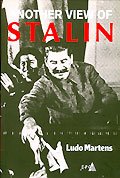
Another View of Stalin by Ludo Martens
http://www.plp.org/books/Stalin/book.html

Labels: , , , , ,


View Post

Tuesday, March 28, 2006

Socialism or Barbarism? Review of "Another View of Stalin"


This book by Ludo Martens of the Worker's Party of Belgium, Another View of Stalin (EPO, Antwerp: 1994.), is pretty incredible. For us, working in the United States where anticommunism is so institutionalized, it is an important book. It is a weapon for communists to use in the ideological front.

For a long time I didn't understand Comrade Stalin. I came from a petit-bourgeois intellectual Marxism, distanced from practice and tied in rather closely to to the humanist/individualist ideologies of the U.S. I read Adorno, Jameson, and Critical Theory. As a young man, a teenager just coming to Marxism, I remember people would say, "but Socialism didn't work," and I would reply, with a fine mixture of youthful optimism and naivete, "but it was never really tried!" Any scientific socialist should be able to see such a statement for the utopianism that it is. Later my utopianism became more nuanced and sophisticated as I studied philosophy formally. It was only when I came to Mao Zedong's writings and the experience of the Chinese Revolution that I could begin to reappraise Stalin, the USSR, and the world communist movement as a whole. Whatever his errors may have been, Mao was a breath of fresh air, so clear and simple, yet sharp as a razor - so practical and useful! And yet Mao was a "Stalinist." So I had to ask, was Stalin a deviation from "true" Marxism and even from Leninism (and where did that leave Mao?), or was Stalin a genuine Marxist-Leninist? What did this say about socialism, what it is and what it isn't? What did this say about what socialism could be?

Through a more thorough study of Marxism and of history, I came to see that Stalin was a great Marxist-Leninist and that the USSR, at least until the Krushchev years, provided a shining example of what Marxism was when applied. But why did it "fail" and where did that leave us? It was only much later that I came to understand the particulars of the sequence of events and what Mao Zedong calls the "two line struggle," whereby in the transitional society that socialism is (not what Marx calls a "mode of production" but something between the capitalist and communist modes) contradictions are intensified and class struggle along with it. Nothing is assured just because the proletariat has seized state power.

Fast forward a bit. I attended a recent conference where a lot of Trotskyite groups tabled. On the way to conference, in the van that we had rented for our mobilization, I was talking about Soviet history, about Stalin and his contributions to building socialism, and about the slow death of the Soviet system as the sickness of revisionism tore the USSR apart from Krushchov to through Gorbachav, to Yeltsin and the liquidation of the CPSU and the rise of the oligarchs. Having read Another View of Stalin, it was an easy thing to address such questions as, "What about Lenin's Will?", "What about the Purges and Show Trials?", "What about the Gulag? And the millions killed?" "The lack of democracy?" "The forced collectivization?" "What about Trotsky?" Martens goes into all of this. He addresses the usual criticisms of Stalin, going after their sources, showing how they don't hold up to any scientific analysis of history, situating them in their actual historical conditions, from which they are so easily and with such cleaverness removed. He exposes the agendas of Stalin's critics in the most thorough way. But people didn't understand why all these Trots were around. They were very confusing, and after all, they said all the same things about Stalin that their highschool teachers had been saying all along!

And this brings us to the question of revisionism. Some don't see why this question of Stalin is so important for Marxist-Leninists today. Stalin is dead, after all, and this isn't Russia. In the last instance, it comes down to the very essense of Marxism, to historical materialism, to the scientific analysis of social, political and economic change. Had socialism "ever been tried" and did it work? If our answer is yes, then we must come up with a balance sheet of its successes and failures, we must go into the particulars, the local and geopolitical contradictions, the historical milieu. If no, we must discern how socialism in the USSR, Eastern Europe, Southeast Asia or China differed from "true" socialism, and how is this "true" socialism to ever be achived given where are and what we know about class society, imperialism, uneven development and so on? The question of Stalin is central to this - the question of the architect of the first Socialist society and leader of the international communist movement for so many crucial decades. To defend Stalin one must have a firm grasp of history. To be a Trotskyite one must only say, "but think of what it would have been like if..." The concern is not with what happened. Trotskyite "theory" doesn't hold water. And we know, as Mao Zedong has said, the basis of Marxist epistemology, that is the basis of all scientific knowledge, is practice.

A lot of people I know who have read this book on Stalin by Comrade Martens have been stunned by the degree of the lies perpetuated to attack the architect of socialism. It is a common thread that links all of communisms enemies: Imperialists, Fascists, Trotskyites, Revisionists, etc. Comrades like it because it is a weapon. Anti-capitalist fellow-travellers like it because it reaffirms what they have always suspected - that the greatest enemies of capitalism and imperialism are the ones who are most villified by the petit-bourgeois lackeys of international monopoly capital. Today as the Communist Party of Nepal (Maoist) stands on the verge of founding the world's next socialist state, we see it happening again with the new "biography" of Mao Zedong, which is nothing but propaganda dressed in the trappings of history.

One need not limit oneself to Krushchov's secret speech to the XXth Congress to find this problem. One can look in philosophy as well. The "Marxist" Humanists, celebrants of the velvet (counter-)revolution like Dunayevskaya (secretary of Trotsky and founder of News & Letters), Kolakowski ("Marxist" revisionist author of the most anti-Marxist philosophical text yet written, the three volume Main Currents of Marxism), and even Alain Badiou ("post-Maoist" methematician and philosopher who calls both the Chinese Cultural Revolution and the Solidarity movement in Poland "obscure events" to study and upon which to refound the leftist project). And we can see where that leads. The humanists are liberals, as Louis Althusser has pointed out in his cleaver syllogism: "All humanists are liberals; Eric Fromm [famed "Marxist Humanist"] is a humanist; Fromm is a liberal." Kolakowski sings the praises of revisionism to no end, and Badiou's OP is at best infantile leftist and worst completely reformist. Where does this revisionism lead? In the Soviet Union and the Warsaw States it led to capitalist restoration in its most barbaric form. Humanism restored gangster-liberalism in the Soviet Bloc. It is easy when you start talking about "universal human rights" to forget that this means bourgeois right, and that in the end, "universal human rights", "Socialism with a human face" and what have you, is a defeat for the working class.

It is odd that when anyone wants to talk about the "true essense" of Marxism, or a "return to Lenin" it is that old renegade Kautsky, the social-democrat who wanted a reformed capitalism, that they dredge up in order to liquidate the CP and liberalize the state and economy. And nobody embodies Kautskyism like Tony Blaire's Labour Party as they unite with U.S. imperialism to rob the Middle East of all of its resources. Mao Zedong puts it very simply: never forget class struggle.

I am an activist, a militant involved in the daily struggles of the working and oppressed people. I argue for socialism, for Marxism-Leninism. To do this, this book by Comrade Martens is useful, especially with students and young people. So many people see these problems of exploitation, poverty, national oppression, sexism, and so on. They see that they are systemic, but so often it stops there. Because the radical alternative is "Stalinism" so many people settle for an ineffective social-democracy, a vain attempt to reform capitalism, or a cynical pessimism. But this book does well to demonstrate that, situated within its historical context, Communism is a good thing. And, as Lenin would have it, the dictatorship of the proletariat is "a million times more democratic" than anything else we have ever seen.

Stalin, architect of socialism, is a shining example to genuine Marxist-Leninists everywhere.

in unity and struggle,
Comrade Zero

(Another View of Stalin can be purchased from the Stalin Society. For a good discussion on revisionism in the USSR, perhaps one that is a bit more nuanced than Restoration of Capitalism in USSR by Martin Nicolaus that so many Maoists swear by, see Ludo Martens. USSR: The Velvet Counter Revolution. EPO, Brussles: 1991. For more on the role of Stalin, the anti-revisionist movement and a critical evaluation of the role of Mao and the CPC, see also Ludo Martens. "On Certain Aspects of the Struggle Against Revisionism". PTB, Brussles: March, 1995. [.doc])

Labels: , , , , , , , , , , ,


View Post